
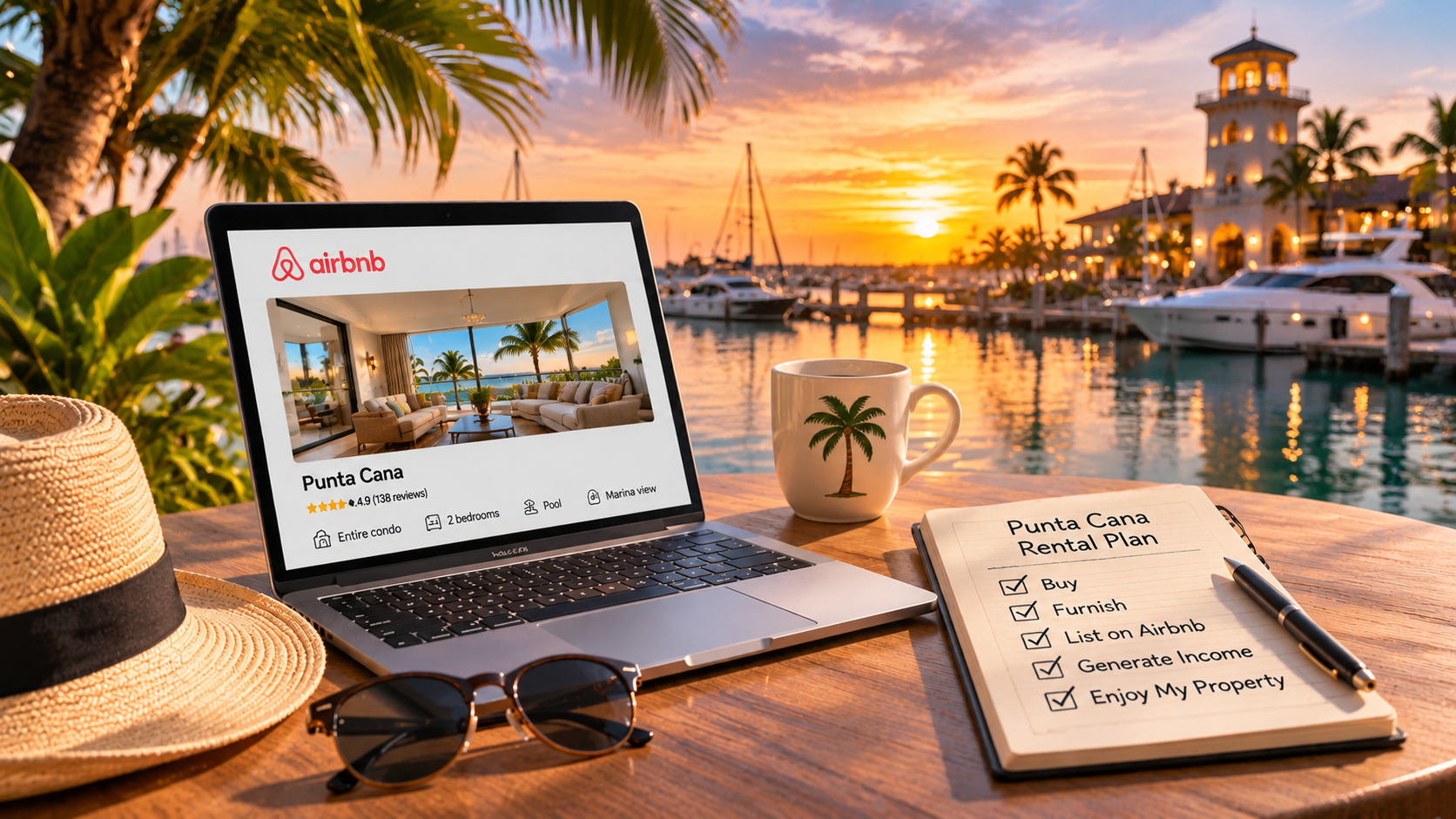
Every week, I speak with buyers who are purchasing property in Punta Cana with a very specific investment strategy: buy a property, place it on Airbnb or another short-term rental platform, generate rental income, enjoy the property themselves for part of the year, and benefit from long-term appreciation.
It is a strategy that can work very well in Punta Cana.
The Dominican Republic has one of the strongest tourism markets in the Caribbean, and areas such as Punta Cana, Bávaro, Cap Cana, and Uvero Alto continue to attract millions of visitors every year.
But when buyers ask me, “Is it complicated to rent my property short-term in the Dominican Republic?”, my answer is usually simpler than they expect:
Today, it is relatively straightforward.
The Dominican Republic is gradually formalizing and modernizing the rules surrounding short-term rentals, particularly from a tourism and tax perspective. However, the regulatory system is still evolving, and many of the registration and reporting mechanisms being discussed or developed are not yet operating in the same way they do in highly regulated markets such as New York, Barcelona, or Miami.
For a buyer today, the important thing is understanding what actually matters now — and what is still being developed.
The Short-Term Rental Market in Punta Cana
Short-term rentals have become an important part of the Dominican tourism ecosystem.
MITUR’s own tourism statistics track Airbnb and private accommodation as distinct categories, reflecting how significant this segment has become within the country’s visitor economy.
For property owners, this creates an attractive opportunity.
A well-located condo or villa can potentially generate income throughout the year while the owner retains the flexibility to use the property personally.
And unlike some destinations where short-term rentals have become heavily restricted, Punta Cana continues to have a large and active vacation-rental market.
That does not mean there are no rules.
It means the rules are currently less burdensome in practice than many international buyers assume.
So, Is Airbnb Legal in Punta Cana?
Yes.
Short-term rentals are widely operated throughout Punta Cana, Bávaro, Cap Cana, and the surrounding areas.
There is currently no universal system requiring every individual condo or villa owner who lists a property on Airbnb to complete the extensive licensing and inspection process described in many articles about other international markets.
This is an important distinction.
The Dominican government is working toward greater formalization of the short-term-rental sector, and MITUR has continued developing its tourism registration and licensing infrastructure.
However, the regulatory framework is still evolving, and the process should not be confused with a fully implemented Airbnb licensing regime requiring every individual property owner to obtain a specific MITUR registration number before renting.
For the typical Punta Cana investor, the process today is considerably simpler.
Who Regulates Tourism and Rental Activity in the Dominican Republic?
There are several government institutions that can have a role in the broader regulatory environment.
MITUR — Ministry of Tourism
The Ministry of Tourism is responsible for regulating and supervising tourism activities in the Dominican Republic.
MITUR has an established licensing framework for tourism businesses and accommodation establishments, including hotels, apart-hotels, and other formal tourism operations.
At the same time, the government is continuing to develop its systems for registering and monitoring different types of tourism activity.
For an individual investor purchasing a condo or villa and renting it on Airbnb, however, there is currently not a blanket requirement to go through the full MITUR registration process described in older or more aggressive interpretations of the rules.
That may change as the government continues formalizing the sector.
DGII — Dominican Tax Authority
The Dirección General de Impuestos Internos (DGII) is responsible for the country’s tax system.
Rental income can have tax implications depending on how the property is owned, how it is operated, the nature of the rental activity, and whether the owner operates personally or through a Dominican company.
The important point for buyers is that the Dominican Republic is currently moving toward greater formalization of short-term-rental taxation and reporting.
The government has been working on mechanisms that could make rental activity more visible within the tax system, particularly as the digital economy and platforms such as Airbnb continue to grow.
However, these developments should not be presented as though a fully operational, universally enforced Airbnb tax-registration system is already in place for every individual owner.
If you are purchasing multiple properties or operating rentals as a larger business, it is sensible to speak with a Dominican accountant or tax attorney about the appropriate structure.
For a typical individual investor purchasing one property, this is generally a much simpler issue than the regulatory process described in many online guides.
What About MITUR Registration?
This is probably the biggest misconception I see in articles about short-term rentals in the Dominican Republic.
You may read that every Airbnb owner needs to:
-
Register the property with MITUR
-
Have the property inspected
-
Obtain a tourism registration number
-
Display that number on Airbnb
-
Renew the registration every two years
-
Obtain multiple certificates before renting
That is not an accurate description of the practical process currently faced by the typical Punta Cana condo owner.
MITUR does have formal licensing and registration systems for tourism businesses and accommodation establishments, and those systems are continuing to evolve.
But the typical owner of a condo or villa who wants to place the property on Airbnb is not currently going through the four-step licensing procedure described above as a prerequisite to operating a short-term rental.
This is an area where the Dominican Republic is still developing its regulatory framework.
For buyers, that means the situation is relatively straightforward today, while also being worth monitoring as the government continues to formalize the sector.
What About Taxes on Airbnb Income?
This is an area where it is important to distinguish between existing tax principles and new enforcement or reporting systems that are still being developed.
Rental income is not automatically tax-free simply because the property is rented through Airbnb.
Depending on the ownership structure and nature of the activity, Dominican tax rules can apply to rental income and certain commercial rental services.
For example, the DGII has previously issued guidance indicating that certain commercial rental arrangements involving Airbnb can be subject to ITBIS and corresponding tax obligations.
At the same time, the Dominican Republic is currently working toward a more formalized system for identifying, reporting, and regulating income generated through the digital rental economy.
For the average buyer, this should not be viewed as a reason to avoid short-term rentals.
Rather, it is something to keep in mind as the market develops.
If you are purchasing one property as an investment, your accountant can advise you on the appropriate treatment based on your individual circumstances.
If you are building a larger rental portfolio or operating through an SRL, professional tax advice becomes more important.
What Buyers Should Actually Check Before Purchasing
For someone buying property specifically for Airbnb or vacation rentals, I would focus much more attention on the property itself and the condominium’s rules than on a complicated licensing process that is not yet fully operational.
Here are the questions that really matter.
1. Does the condominium allow short-term rentals?
This is probably the single most important question.
Every condominium has its own reglamento de copropiedad and internal operating rules.
Some developments are specifically designed around vacation rentals.
Others may have minimum rental periods or restrictions.
Before purchasing, confirm that short-term rentals are permitted.
2. What is the building’s rental culture?
There is a major difference between a building where short-term rentals are actively embraced and one where they technically exist but are discouraged by the administration.
Ask:
-
Are other units listed on Airbnb?
-
Does the building have frequent vacation-rental guests?
-
Does reception handle check-ins?
-
Are there established procedures for guests?
-
Does the administration work with property managers?
In Punta Cana, practical experience within the building can be just as important as what is written in the rules.
3. Is there a minimum rental period?
Some buildings may allow rentals but establish a minimum number of nights.
That can have a meaningful impact on your expected occupancy and revenue.
4. Does the building charge any rental-related fees?
Some condominium communities may have additional fees or requirements related to rental activity.
These should be included in your investment calculations.
5. Is professional property management available?
If you live abroad, this can be more important than any government registration.
A good management company can take care of:
-
Guest communication
-
Check-in and check-out
-
Cleaning
-
Maintenance
-
Guest issues
-
Airbnb/VRBO listing management
-
Pricing and calendar management
-
Local coordination
The objective is to make owning a rental property in Punta Cana relatively passive, even when you are living outside the Dominican Republic.
What Is Changing in the Dominican Republic?
The direction is clear: the Dominican Republic is becoming more organized and more sophisticated in how it handles tourism, digital platforms, and short-term rental activity.
MITUR already operates digital systems for tourism services and continues expanding its registration infrastructure.
The tax authorities are also increasingly interested in bringing more economic activity into the formal tax system.
But there is an important difference between a government developing and implementing a regulatory framework and a fully operational system that every Airbnb owner must already follow.
Those are not the same thing.
As of 2026, Punta Cana remains a relatively accessible market for investors who want to participate in short-term rentals.
The regulatory environment is evolving, but it has not reached the level of bureaucracy found in some of the world’s most heavily regulated vacation-rental markets.
What Happens If the Rules Change?
This is actually one of the reasons I recommend buying the right property rather than simply buying the cheapest property.
A good investment should remain attractive even if the regulatory environment becomes more formal.
Look for:
-
Strong tourism demand
-
A building that openly accommodates short-term rentals
-
Professional management infrastructure
-
Good location
-
Strong amenities
-
Easy guest access
-
A condominium administration experienced with vacation rentals
-
Healthy rental demand
If the Dominican Republic eventually introduces additional registration or reporting requirements, a professionally operated property in a well-managed development should be much easier to adapt.
In other words, the goal isn’t to avoid regulation. The goal is to buy an asset that can adapt to reasonable regulation.
The Bottom Line for Airbnb Investors
If you are considering buying a property in Punta Cana specifically for short-term rental purposes, there is no reason to be intimidated by the current regulatory environment.
The Dominican Republic is moving toward greater formalization, particularly around tourism and taxation.
But the short-term rental market is already active, and the typical individual investor is not currently required to navigate the extensive MITUR licensing process described in many articles.
The most important thing today is choosing the right property.
Before you buy, confirm that:
-
Short-term rentals are permitted by the condominium
-
The building has a healthy rental culture
-
There are no restrictive minimum-stay requirements
-
The property has strong tourism demand
-
Management is available if you need it
-
The numbers work after management, maintenance, and operating costs
Then keep an eye on the regulatory environment as it develops.
That’s a much more realistic approach to buying an Airbnb investment in Punta Cana in 2026.
How I Help Buyers Evaluate Rental Properties
I have been working in the Punta Cana real estate market since 2012, helping international buyers evaluate not only the purchase itself but the investment strategy behind it.
When I evaluate a property for a buyer interested in short-term rentals, I look beyond the advertised price and projected yield.
I want to know:
Can this property actually work as a rental?
That means looking at the location, condominium rules, rental culture, management options, operating costs, projected occupancy, purchase price, and long-term appreciation potential.
Because a good Airbnb investment isn’t simply a property that can be rented.
It is a property that makes sense as an investment.
If you are considering buying in Punta Cana, Bávaro, or Cap Cana with the intention of generating short-term rental income, I would be happy to help you evaluate the opportunity and identify which properties make the most sense for your strategy.
Ready to buy in Punta Cana with a clear strategy?
Explore the Punta Cana Buyer’s Guide for information about the purchase process, financing, legal considerations, and what to look for when evaluating an investment property.
You can also browse our current selection of Punta Cana investment properties or contact me directly to discuss your investment goals.
