
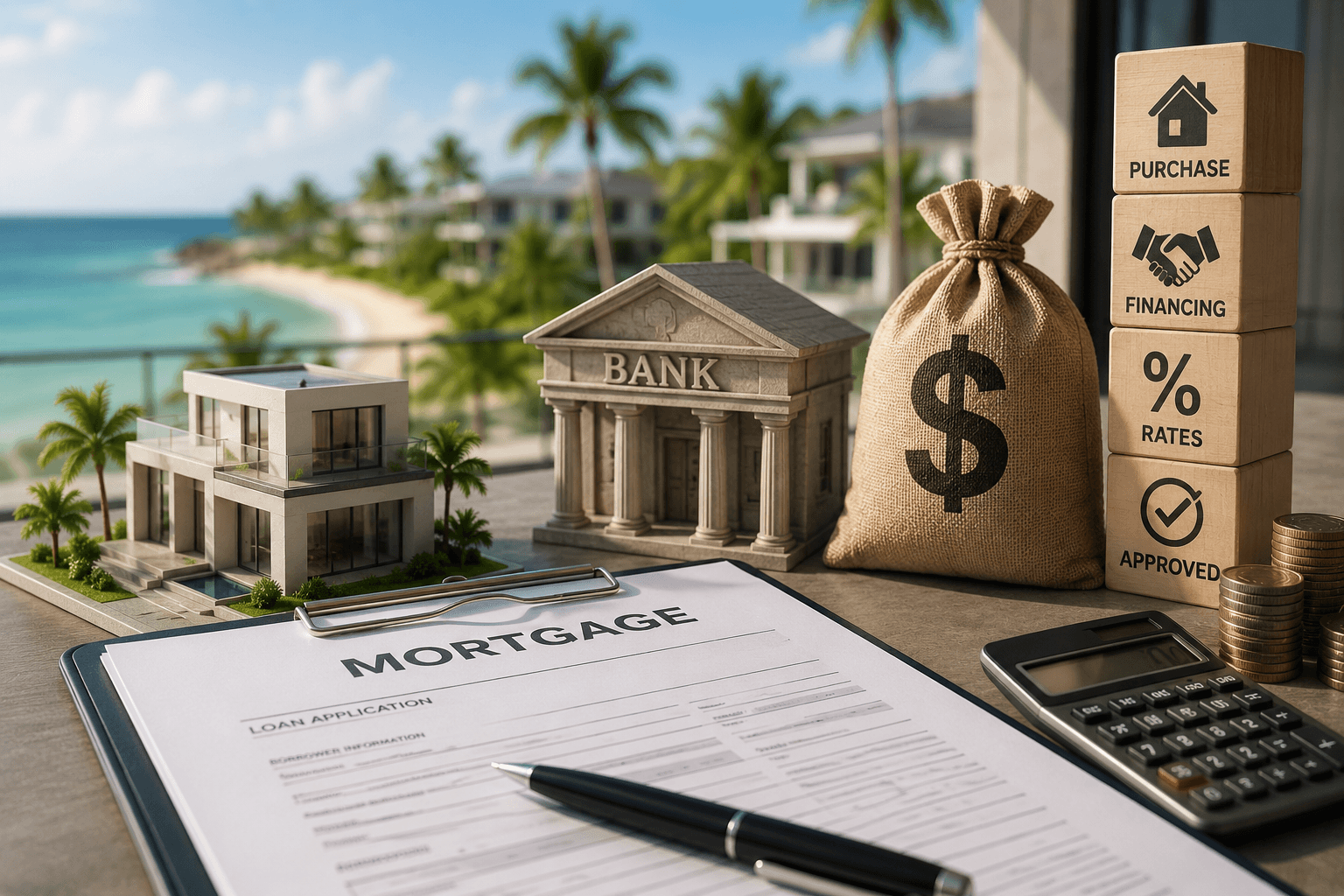
The number one question I get from buyers after they’ve found a property they want is: Can I finance this?
It’s a reasonable question. Most foreign buyers arrive in Punta Cana with the assumption that their options are limited to cash, that mortgages and financing are either unavailable or so unattractive that they’re not worth considering. The reality is more nuanced, and significantly more interesting, than that assumption suggests.
Financing is available to foreign buyers in the Dominican Republic. But the mechanics are different from what you’re accustomed to at home, different institutions, different structures, different rates, and a very different timeline. Understanding how it actually works will help you plan a smarter acquisition and avoid the expensive mistakes that come from misplaced expectations.
This is the complete picture of how foreign buyers finance DR real estate in 2026.
First: Why Most DR Real Estate Transactions Are Cash
Before getting into the financing options, it’s worth understanding why the majority of foreign real estate purchases in the DR are all-cash transactions, because that context shapes everything else.
The Dominican Republic’s mortgage market is structurally different from mature markets like the US, Canada, or the UK. Interest rates are higher, loan-to-value ratios are lower, and the administrative process is considerably more involved for non-resident foreign nationals. For buyers coming from markets where 30-year fixed mortgages at 6–7% are standard, the local Dominican bank mortgage environment, with peso-denominated loans at 12–18% and USD-denominated loans at rates that still carry a premium over US mortgage rates — requires a mental adjustment.
Additionally, much of the most attractive inventory in the Punta Cana market, particularly pre-construction developments — is specifically designed around a cash-installment payment model. Developers offer staged payment schedules (20% at signing, 30% at construction midpoint, 50% at delivery) that are, in practice, a form of seller financing at 0% during the construction period. This structure is designed to make purchases accessible to foreign cash buyers without requiring them to come up with 100% of the purchase price at once.
None of this means that financing is impossible or even inadvisable. It means you need to understand which financing mechanisms actually make sense for foreign buyers, and which ones the local market has not built for your profile.
Option 1: Dominican Republic Bank Mortgages
Local Dominican banks, including Banco Popular, Scotiabank (DR), BanReservas, and Banco BHD — do offer mortgage products to foreign buyers. The mechanics and feasibility depend heavily on your credit score and the specific property value.
Peso vs. Dollar Mortgages
Dominican banks offer both peso-denominated and USD-denominated mortgage products for foreign buyers. The distinction matters enormously.
Peso mortgages carry current rates in the 12–18% annual range. For a buyer earning income in USD or CAD, a peso mortgage also exposes you to currency exchange risk, if the peso strengthens against your home currency (very unlikely), your effective cost increases. Most foreign buyers avoid peso-denominated mortgages for these reasons.
USD-denominated mortgages are more appropriate for foreign buyers. Rates currently range from approximately 7–10% annually, depending on the institution, the property, and your financial profile. These are higher than US or Canadian mortgage rates, but they eliminate the currency mismatch problem.
What Banks Require From Foreign Buyers
To qualify for a mortgage at a Dominican bank as a foreign national, you’ll typically need to provide:
- Valid passport and proof of residency status (DR residency is required by some institutions for their best rates; others lend to non-residents but with stricter conditions)
- Proof of income — typically two years of tax returns from your home country, plus recent pay stubs or business financials if self-employed
- Bank statements — usually 3–6 months of personal and/or business account activity
- Credit report from your home country (international credit bureaus can provide this)
- Property appraisal conducted by a DR-licensed appraiser acceptable to the lending institution
- Clean title verification — the bank will conduct its own due diligence on the property
The documentation process is more extensive than most buyers anticipate, and the timeline from application to approval at a Dominican bank typically runs 60–120 days for foreign national applicants. If your transaction has a specific closing timeline, this lead time needs to be factored in from the earliest stages.
Loan-to-Value (LTV) for Foreign Buyers
Dominican banks generally offer 50–60% LTV for foreign national buyers on residential and vacation property. This means you will need to bring a minimum of 40–50% of the purchase price as a down payment. Some institutions cap foreign national exposure at 50% LTV.
Compare this to 80–95% LTV that may be available in your home market, and the cash requirement becomes clear. A $300,000 Punta Cana property might require $120,000–$150,000 in down payment through a local bank mortgage which, for many buyers who could finance more aggressively at home, makes the arithmetic of local bank financing less attractive versus the alternatives below.
When Dominican Bank Financing Makes More Sense
Local bank financing makes the most sense for buyers who:
- Already have DR residency (reduces rates and increases LTV availability)
- Are acquiring a longer-term primary or secondary residence rather than a short-term investment
- Cannot or prefer not to access capital through home-country mechanisms
- Are purchasing established resale properties (which are more straightforward to finance than pre-construction)
For investment buyers focused on the rental yield model, the rate environment on local bank mortgages is a significant headwind. At 8–9% annual interest on a USD mortgage, the debt service pressure on a property yielding 7–9% gross rental return can be uncomfortable. Cash or home-country financing typically produces better investment economics.
Option 2: Developer Financing on Pre-Construction
This is where the DR market has genuinely innovated in ways that serve foreign buyers well, and it’s the financing mechanism most buyers actually use.
Virtually every pre-construction development in the Punta Cana corridor offers structured payment plans that allow buyers to acquire a property without a traditional mortgage. The standard structure:
- 20–30% at signing (typically a deposit to reserve the unit, followed by the initial payment at formal contract signing)
- Staged payments during construction — 20-30% often distributed across 12–36 months depending on the development timeline, with a milestone payment at structural completion
- Balance at delivery — the remaining 40–50% is due when the unit is complete and title is transferred
This structure essentially converts the developer into your lender during the construction period, at 0% interest. On a 24-month construction timeline, a buyer who puts 40% down at signing and pays the balance at delivery has effectively had 60% of the purchase price financed at zero cost for up to two years.
The math is meaningful. On a $200,000 purchase, the 60% balance ($120,000) financed at 0% for 24 months vs. a bank loan at 8.5% represents approximately $10,200 in avoided interest cost, plus the benefit of having your capital deployed elsewhere during that period.
What Happens at Delivery
When the pre-construction property is delivered, the buyer has several options for settling the balance:
1. Cash payment — the most common scenario; the buyer has deployed capital strategically during construction and settles at closing 2. DR bank mortgage at delivery — the buyer pre-qualifies for a local bank mortgage and closes simultaneously with property delivery 3. Home-country HELOC or refinancing — covered in the next section 4. Developer extended financing — some developers offer continued financing post-delivery, though at rates comparable to or higher than local bank rates
The timing advantage of pre-construction developer financing is real and substantial. For buyers with the liquidity to manage staged payments over the construction timeline, it’s genuinely the most favorable financing structure in the DR market.
Option 3: Home-Country Financing — The Most Underused Option
This is the financing strategy I recommend most often to foreign buyers who have meaningful home equity or investment assets, and it’s the one that generates the most surprise when I describe it.
The concept is straightforward: Rather than navigating the DR banking system at 8–9% USD rates, finance the purchase by leveraging assets you already own at home, typically through a home equity line of credit (HELOC), cash-out refinancing on a primary residence, or a securities-backed loan, at your home country’s rates.
For a US buyer with a home that carries substantial equity, a HELOC in 2026 is accessible at rates in the 6–9% range. A Canadian buyer with significant equity in a principal residence can access similar mechanisms. UK buyers have their own home equity access vehicles.
Why this often works better:
- Your home-country lender knows you. You have an established credit history, income documentation on file, and a relationship. Approval timelines are weeks, not months.
- Your home-country interest rate environment, particularly for secured lending against a primary residence, is typically more favorable than the DR bank’s foreign national rate.
- The DR transaction remains a cash purchase from the seller’s perspective — cleaner, faster, with no contingencies on foreign bank approvals.
- The interest on a HELOC used for investment property may be deductible in your home jurisdiction (verify with your tax advisor — this varies by country and individual circumstances).
The key consideration: This approach works well for buyers who have meaningful equity in a home-country asset and are comfortable with the liability structure. It should be evaluated in the context of your complete financial picture, not in isolation. If leveraging your primary residence to finance a Caribbean investment property creates stress in your overall balance sheet, the comfort of lower DR bank rates may not be worth the structural trade-off.
But for buyers who have the equity and are asking “why would I pay 9% at a Dominican bank when I can access 7.5% against my Atlanta house?”— the answer is: you generally shouldn’t.
Option 4: International Mortgage Brokers Specializing in Offshore Property
A small but growing sector of international mortgage finance serves buyers acquiring property outside their home country. Several US, UK, and Canadian-based firms specialize in arranging financing for Caribbean real estate, including the Dominican Republic.
These firms work with a network of international lenders, typically offshore banks domiciled in jurisdictions like the Cayman Islands, BVI, or Panama — that have experience with DR property collateral and foreign national borrowers.
What they can offer: USD-denominated mortgages at rates that sometimes compete with or beat DR local bank rates (currently in the 6–8% range), with LTV ratios of 55–70%, and a more streamlined documentation process for foreign nationals than navigating a DR institution cold.
The trade-offs: These products typically come with origination fees, legal fees on both the lending side and the DR side, and ongoing administrative requirements. The total cost of capital — including fees may be higher than it appears on the headline rate.
Who should explore this route: Buyers who want long-term financing (10–20 years), don’t want to leverage home-country assets, and are acquiring at a price point where the cost of arranging the finance (typically $10,000–$20,000 in fees) is proportionate to the loan amount. For purchases under $200,000, the fees often make this less attractive than alternative structures.
Option 5: Seller Financing
On resale properties — particularly those owned by individuals rather than developers, there is occasionally an opportunity to negotiate seller financing, particularly when the seller is a foreign national who is liquidating a DR property as part of estate planning or portfolio rebalancing.
Seller financing in the DR typically takes the form of a private mortgage agreement (documented in the purchase contract) where the seller accepts a portion of the purchase price over time, with interest, secured against the property.
The advantages: Potentially flexible terms, faster approval than a bank, and no origination fees.
The disadvantages: Most sellers in the DR resale market want or need the full purchase price at closing. Seller financing is the exception, not the rule. When it’s available, it requires careful legal documentation and a clear understanding of the default provisions.
This is not a reliable primary strategy. It’s a supplemental option worth exploring in specific resale situations where the seller’s circumstances make it workable.
The True Cost of Financing: A Working Example
To make this concrete, here’s a simplified comparison for a $250,000 property acquisition in Punta Cana:
| Financing Approach | Down Payment | Rate | Monthly Debt Service (20-yr) | Total Interest (20-yr) |
|---|---|---|---|---|
| All-cash | $250,000 | — | — | — |
| DR Bank Mortgage (70% LTV) | $70,000 | 8.5% USD | ~$1,538 | ~$194,000 |
| US HELOC (leveraging home equity) | $250,000 cash (HELOC drawn) | 7.5% | (HELOC payment on draw) | Varies |
| Pre-construction developer plan | $100,000 (40% at signing) | 0% during build | $150,000 at delivery | $0 during build period |
The pre-construction route, when available, consistently offers the best short-term financing economics. The HELOC route often offers the best long-term economics for buyers with home-country equity. The DR bank route is the most accessible for buyers who need in-market financing without leveraging home-country assets.
What Residency Does (and Doesn’t) Do for Your Financing Options
I get this question regularly: Will getting Dominican Republic residency help me get better financing?
The honest answer: marginally, for local bank products specifically, but residency is not a prerequisite for accessing the best financing structures for most foreign buyers.
Dominican residency (particularly temporary or permanent residency) can:
- Qualify you for slightly better LTV ratios at some local institutions
- Reduce documentation requirements for local bank applications
- Potentially improve your rate by 0.5–1.5% at some banks
Dominican residency does not:
- Give you access to subsidized government mortgage programs (which are targeted at Dominican nationals for primary residential use)
- Materially change the economics of developer payment plans, home-country financing, or international mortgage brokers
- Eliminate the documentation requirements for demonstrating income and creditworthiness
For buyers who intend to spend significant time in the DR and are planning long-term, obtaining residency has independent benefits (visa-free extended stays, tax treaty advantages, simplified logistics). But acquiring DR residency specifically to access better mortgage terms is not, in most cases, the right analysis. The improvement in mortgage economics rarely justifies the residency process as a standalone motivation.
Legal Considerations: Structuring the Purchase Correctly
Regardless of which financing route you use, the legal structure of the purchase matters, and interacts with your financing in ways you need to understand before closing.
Corporate vs. personal ownership: Some foreign buyers acquire DR property through a Dominican SRL (LLC equivalent) or an offshore holding company. If you intend to finance through a DR bank, note that many local institutions prefer to lend against personally-owned property. Corporate ownership can complicate (and sometimes prevent) local bank mortgage applications. If you’re considering a corporate structure for tax or estate planning reasons, discuss the interaction with your financing plan before executing either.
Mortgage registration: When a DR bank or any lender places a mortgage against a Dominican property, that mortgage is registered against the title certificate at the Title Registry. This is a formal legal encumbrance that must be discharged before the property can be transferred. Any financing arrangement needs to be formally documented and registered, a private handshake arrangement is not enforceable against the title and creates legal risk.
Title insurance: Not common practice in the DR, but available through certain international insurers. For financed purchases, some international lenders require title insurance as a condition of the loan. Budget for this if applicable.
Your DR real estate attorney, not the developer’s attorney, your own independent attorney, should review all financing documentation before you sign anything.
Frequently Asked Questions
Can I use my 401(k) or retirement account to buy DR property?
Technically, a self-directed IRA can be structured to invest in international real estate, including DR property. This is complex, has significant IRS compliance requirements, and generally requires a specialized custodian. It is not a mainstream approach and requires specialist guidance. For most buyers, it’s simpler to use taxable assets or HELOC/refinancing for the DR acquisition.
Do I need a DR bank account to finance or purchase property?
No, you can purchase property in the DR and receive rental income as a foreign national without a DR bank account, though having one simplifies ongoing management. Some DR banks do require an account with them as part of their mortgage product. If your lender requires this, factor in the account opening timeline (typically 2–4 weeks for non-residents).
Can I refinance a DR property after acquisition?
Yes, refinancing a DR property is possible through the same bank channels described above. The process and timeline are similar to the initial mortgage application. Many buyers who purchase with developer financing or home-country capital choose to refinance into a local bank product post-delivery if their DR residency situation or financial profile has improved.
What happens to my mortgage if I want to sell the property?
A mortgaged DR property can be sold, but the mortgage must be discharged at or before closing — typically from the proceeds of the sale. Your DR attorney and the buyer’s attorney coordinate this as part of the title transfer process. Ensure your mortgage agreement doesn’t have early repayment penalties that would affect your net proceeds.
The Bottom Line
Financing a Dominican Republic real estate purchase as a foreign buyer is not only possible, it’s a decision that deserves as much strategic thought as the property selection itself. The right financing structure depends on your residency status, the type of property you’re acquiring (pre-construction vs. resale), your home-country asset base, your investment horizon, and your tolerance for financial complexity.
The buyers I’ve seen make this work well are the ones who evaluate their complete financial picture, not just what’s available in the DR market, and match the financing vehicle to their specific circumstances. That sometimes means a DR bank mortgage. More often, it means leveraging a developer’s payment plan, using home-country equity intelligently, or simply buying cash with the confidence that the investment economics justify the capital deployment.
What it almost never means is arriving at this decision at the closing table without a plan. Build the financing strategy before you identify the property or at the very latest, in parallel with your property search, not after you’ve already fallen in love with a unit.
That timing gives you negotiating flexibility, protects your transaction timeline, and ensures the deal you’re closing actually fits your financial reality.
Ready to Run the Numbers on a Real Property?
Financing structures, rental yield modeling, Confotur tax savings, this is the analysis that separates a confident purchase from an expensive guess.
Our Punta Cana Real Estate Buyer’s Guide covers the full financing landscape, legal acquisition framework, and investment modeling for foreign buyers, written by someone who has structured hundreds of transactions over 14 years.
When you’re ready to evaluate specific opportunities with the financing analysis already built in, browse current listings or reach out directly for a conversation about what makes sense for your situation.
Alex Bucher is a licensed real estate broker with Coldwell Banker Prime Realty, based in Punta Cana. He has spent 9 years working exclusively in the Dominican Republic market, specializing in foreign buyer transactions across Cap Cana, Bávaro, and the eastern Dominican coast.
