
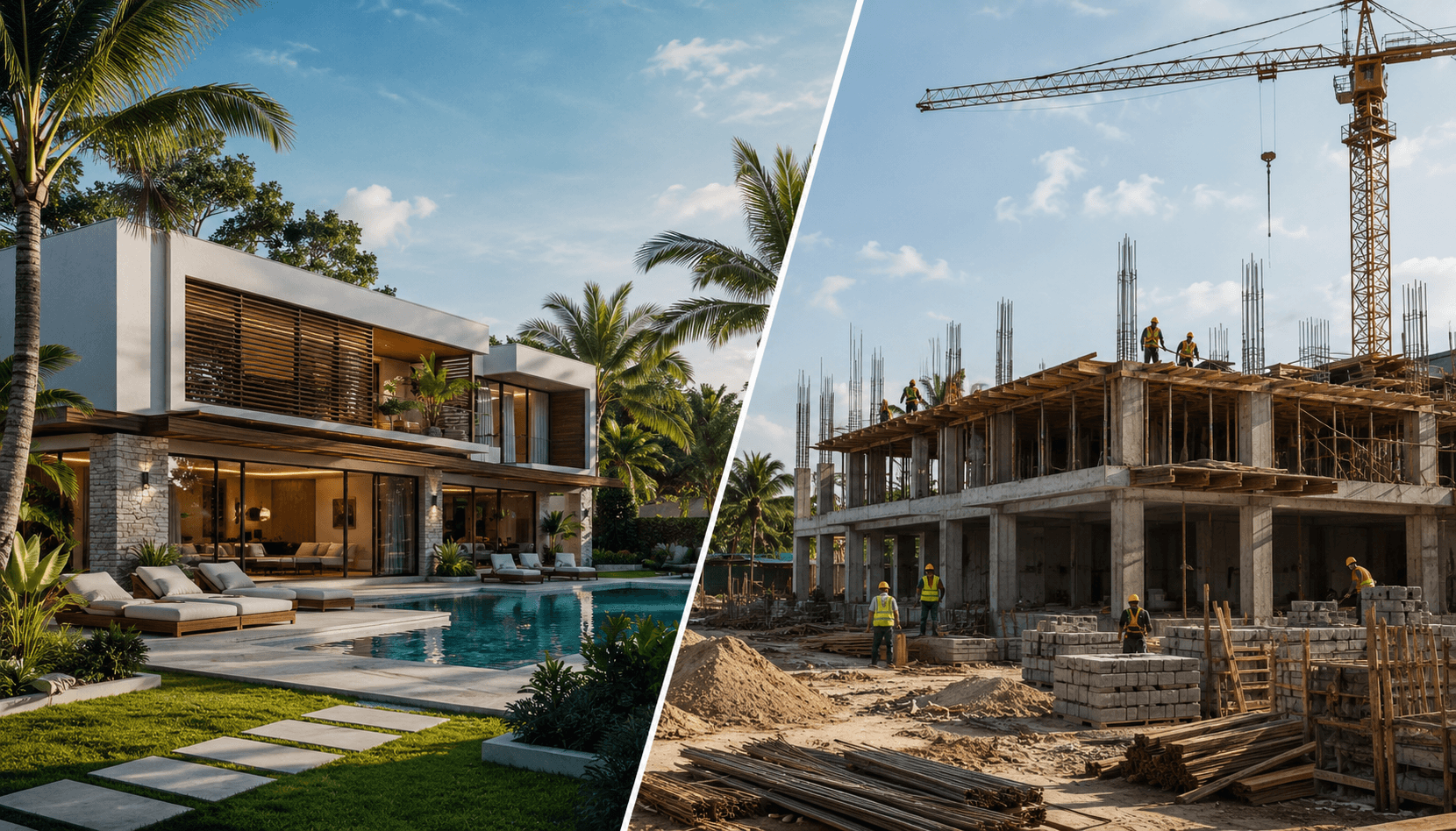
Every buyer who comes to me seriously evaluating Punta Cana hits the same fork in the road: do you buy pre-construction, or do you buy a finished, ready-to-rent resale property?
The short answer is: it depends entirely on what you’re optimizing for. The detailed answer is what this article is about.
I’ve helped buyers on both sides of this decision for 9 years. I’ve watched pre-construction buyers double their equity by delivery. I’ve also watched buyers tied up in construction delays miss two full rental seasons while their capital sat idle. I’ve helped buyers acquire excellent resale properties with established rental histories and immediate cash flow — and I’ve helped buyers get into the wrong resale at a price that didn’t leave enough room for appreciation.
Both strategies work. Both strategies fail. The outcome almost entirely depends on execution, specifically on understanding what each strategy actually requires, and whether your circumstances match those requirements.
Here is how I think about it.
What Pre-Construction Actually Is in Punta Cana
“Pre-construction” or “off-plan” means you’re purchasing a unit before the building is complete, often before a single wall is poured. You sign a purchase agreement, pay a deposit (typically 20–30% of the purchase price at signing), and then make staged payments during the construction period, with the balance at closing when the property is ready to be titled and transferred.
The construction period in Punta Cana typically runs 18 to 36 months from launch to delivery, depending on the developer and the scale of the project. Some smaller boutique developments have delivered in 18–24 months. Some large-scale resort communities have taken 3–4 years from purchase agreement to keys-in-hand.
You are buying a future asset. Until delivery, you hold a contractual right, not a title deed.
What Resale Actually Is in This Market
Resale means purchasing a property that already exists. It has a title deed (Certificado de Título). It may already be in a rental program and generating income. It has a track record, you can request an actual rental performance history, see the HOA financials, walk through the physical condition, and validate the management company’s delivery against the numbers they’re projecting.
Resale inventory in Punta Cana and Cap Cana ranges from properties that are 2–3 years old to properties that are 15+ years old. The age spread matters: a 2019 condo in a well-maintained resort complex is a very different buy from a 2009 condo in a complex with aging infrastructure and a contested HOA.
Understanding which resale inventory is worth buying, and at what price is where local expertise matters most.
The Core Trade-Off: Appreciation Upside vs. Immediate Income
This is the central question, and it determines which strategy belongs in your plan.
The Pre-Construction Case
When you buy from a reputable developer at launch pricing, you are typically acquiring the unit at 25–40% below what comparable product in the same complex will trade for upon completion — sometimes more in rapidly appreciating corridors.
Why does this happen? Developers need to pre-sell inventory to secure construction financing. Early buyers take construction and delivery risk in exchange for pricing that reflects that risk. If the developer delivers on time and on spec, your unit is worth more the day you receive your title than you paid for it. That appreciation is unrealized equity, either a gain you can harvest if you resell, or a stronger net asset position that improves your rental yield calculation on purchase price.
In a healthy pre-construction environment with a credible developer, buyers who purchased at launch and held through delivery have historically seen 25-40% appreciation built in before the first rental booking is made. In markets where the broader corridor appreciated during the construction period, the gains have been larger.
This is the pre-construction case. You are accepting construction-period risk in exchange for a structural pricing advantage.
The Resale Case
Resale pricing reflects current market value. You pay what the market says the asset is worth today, not the discounted price from 24 months ago. You don’t get the built-in appreciation premium.
What you get instead is everything else:
- Immediate income — you can have the property in a rental program within weeks of closing, not months or years
- Verified rental history — you can audit actual booking data, not projected occupancy rates
- No construction risk — the asset exists; you can inspect what you’re buying
- Faster title transfer — closing on a resale in the DR typically takes 45–90 days from accepted offer to title transfer
- Accurate ongoing cost data — HOA fees, maintenance history, actual utility costs are verifiable, not estimated
The resale buyer is optimizing for certainty and immediate cash flow over early-stage appreciation upside.
Breaking Down the Numbers
Let me put some concrete numbers to this.
Pre-Construction Example
A quality 2-bedroom condo in a new development in the Bávaro/Punta Cana corridor, launched mid-2026 at a pre-construction price of $195,000.
- Deposit at signing: $39,000 (20%)
- Monthly Installments during construction: $58,500 (30%) over 24 months in equal installments.
- Balance at closing: $97,500 (50%)
- Estimated delivery: Q3 2028
- Estimated market value at delivery: $225,000–$240,000 based on comparable completed product today
- Built-in appreciation: $30,000–$45,000 before first tenant
From delivery: enters rental program, generating $22,000–$35,000 gross annually (Punta Cana market performance data for well-managed 2BR units in gated community developments).
Gross yield on purchase price: approximately 11–18% gross on $195,000 at full-season occupancy once operational.
But here is the reality check: you did not have rental income for 24+ months during construction. Your capital was deployed in staged payments earning nothing. The true return calculation must account for that cost of waiting.
Resale Example
A comparable 2-bedroom condo in an established Bávaro community area, 4 years old, clean title, already in a professional rental program: $235,000.
- Closing timeline: 60 days
- Rental income starts: 90 days from offer acceptance
- Verified rental income history: $28,000–$32,000 gross in each of the past two years
- Gross yield on purchase price: approximately 12–14% gross on $235,000
You paid more. You didn’t capture the pre-construction appreciation. But you have a verified performing asset within 90 days, and your capital was not idle for 24+ months.
The real comparison is not just price per unit. It’s price per verified-income-producing-unit, adjusted for the time value of the capital deployed during the construction wait.
Confotur: The Tax Variable That Can Shift the Math
The Dominican Republic’s Confotur program (Law 158-01) provides qualifying tourism-sector developments with significant tax benefits: transfer tax exemption (normally 3% of sale price) and annual property tax (IPI) exemption for up to 15 years.
Here is the critical point: most new pre-construction developments in Punta Cana qualify for Confotur; many resale properties carry the remaining years of Confotur eligibility from the original construction, but some do not.
On a $235,000 purchase:
- Transfer tax at 3%: $7,050 — saved entirely if Confotur-eligible
- Annual property tax at 1% of value above the exempt threshold: potentially $1,000–$2,000/year saved for up to 15 years from original approval
Confotur eligibility status is a due diligence item for every transaction, both pre-construction and resale. A resale property within its Confotur window does not necessarily passes the remaining exemption period to the new buyer. A property that has exited its Confotur window loses this benefit given hat it is originally provided to the first buyer. However, there are certain ways to transfer it if structured properly before hand.
Bottom line on Confotur: New pre-construction in qualifying developments is almost always Confotur-eligible. Resale properties require verification, but good-quality, relatively recent developments typically still carry years of eligibility if structured correctly. This needs to be confirmed in due diligence, not assumed.
Construction Risk: The Variable Most Pre-Construction Buyers Underestimate
This is where I will be blunt.
The Dominican Republic has reputable, experienced developers who have delivered dozens of projects on time and on spec. It also has developers who have failed to deliver, gone over budget, stretched timelines by two or three years, or delivered a product materially different from what was sold.
Pre-construction risk in the DR is real. It is not theoretical. I have seen buyers lose deposits to failed projects. I have seen buyers get their units eventually, but after delays that turned a 24-month construction window into 36 months, missing two full rental seasons.
Mitigating pre-construction risk requires:
- Developer track record verification — How many completed projects? What were the actual delivery timelines? What do owners of completed projects say about quality and process?
- Contract review by a DR real estate attorney — Not the developer’s attorney. Your attorney. The purchase agreement needs to address delay penalties, material change provisions, and default remedies.
- Payment Plan structure — Never pay more than the actual construction stage justifies. Front-loading payments to a pre-construction developer before corresponding construction milestones are reached is a risk multiplication error.
- Sales performance — A development that has already pre-sold 60–70% of units by the time you’re evaluating it is structurally less risky than a project launching with 5% sold. Fully subscribed projects have the financing locked; undersold projects may not reach the construction threshold.
Resale carries none of this risk. The asset exists. The developer delivered. The contract is closed. Due diligence on a resale is verification-focused, not forward-looking.
The Timeline Question: When Do You Actually Need This to Perform?
This is the question I ask every buyer first, and it immediately clarifies which strategy makes sense.
“When do you need rental income to start?”
If the answer is “immediately” or “within 12 months” — pre-construction is the wrong strategy. You will be waiting for a construction period with capital deployed and no income generated.
If the answer is “within 3 years” and you have other capital working in the meantime, pre-construction becomes viable, assuming you’re working with a developer whose track record supports the projected timeline.
“Do you want to use the property personally during the early ownership period?”
Pre-construction: you’re not staying in a property that doesn’t exist yet. Resale: you can book your own property within 90 days of closing.
“How important is capital preservation vs. upside?”
Pre-construction is an investment with a meaningful risk component that requires active management. Resale is a more conservative play you’re buying an existing asset at market value with verified performance.
When Pre-Construction Wins
Pre-construction is the stronger choice when:
- You are working with a vetted, established developer with a clean track record of on-time delivery and quality execution
- The pricing discount from market-comparable finished product is 15% or greater — less than that and the time value of waiting starts to erode the advantage
- You have capital available for the installments payment schedule without over-leveraging or tying up funds you’ll need in the next 24 months
- Your rental income timeline allows for a 24–36 month construction period without impacting your investment plan
- The development qualifies for Confotur 15 years property tax exemptions.
- You are in a position to benefit from corridor appreciation — buying into an area that is actively developing and where finished-product prices will rise during your construction window
Pre-construction in Cap Cana’s active development zones, or in emerging corridors like the Punta Cana Village area, has historically produced excellent outcomes for buyers who selected the right developers. The upside is real.
When Resale Wins
Resale is the stronger choice when:
- Immediate cash flow is a priority — you want income within 90 days, not 24+ months
- You want verified rental performance data rather than developer projections
- Your risk tolerance is lower or you’re deploying retirement capital that needs to be preserved
- You want to personally use the property soon — a vacation home you can actually visit
- The resale property you’ve identified still carries Confotur eligibility, reducing the closing cost and increasing ROI
- You’re in a time-sensitive window — exchange funds, capital redeployment, or similar — where certainty and speed matter
- You want to audit the actual product — walk through it, inspect the build quality, meet the management company, talk to other owners
Resale in established, well-managed complexes in the Bávaro area, Cocotal, Vista Cana, or Cap Cana’s marina district consistently generates strong, verifiable returns for buyers who buy correctly.
The Hybrid Play Some Buyers Get Right
A strategy I’ve seen work well for buyers with larger budgets is doing both.
Buy one pre-construction unit from a credible developer in a high-quality new development, capture the pricing advantage and appreciation on the front end. Simultaneously buy one strong resale unit in an established rental complex, generate immediate income that offsets carrying costs during the construction period.
This structure allows the buyer to participate in both the upside of pre-construction and the stability of verified resale income. It requires a larger overall deployment but dramatically improves the risk-adjusted return profile of the portfolio.
Not every buyer has the capital for this. But for buyers in the $400,000–$700,000 deployment range, this two-property approach is often superior to either pure strategy.
The Due Diligence Imperative
Regardless of which path you choose, the single most important protection you have in any Dominican Republic real estate transaction is proper legal due diligence conducted by an independent local attorney.
For pre-construction: title search on the development land, developer entity verification, purchase agreement review, Confotur certificate verification, and construction permit validation.
For resale: clean chain of title on the specific unit’s Certificado de Título, seller identity verification, HOA status and arrears confirmation, Confotur eligibility check, and any encumbrances or liens.
This is not optional. Buyers who skip proper legal representation to save $1,500–$3,000 in attorney fees are taking on risks that can destroy ten times that value. This is true in every real estate market; it is especially true in a market where document verification is more complex than in North American or European systems.
The Bottom Line
Pre-construction and resale are both legitimate, intelligent strategies in Punta Cana’s 2026 market. The question isn’t which is universally better, it’s which fits your specific circumstances.
Choose pre-construction if you have a vetted developer, a timeline that supports waiting 24–36 months, the capital for staged payments, and you’re prepared to do rigorous due diligence on the developer and contract structure. The pricing advantage and built-in appreciation can significantly outperform resale when executed correctly.
Choose resale if you want immediate income, verified performance data, and a more conservative risk profile, or if you want to use the property personally in the near term. A strong resale in an established Punta Cana complex is a high-performing asset that delivers excellent returns without the construction-period complexity.
In either case, what makes or breaks the outcome is not the strategy in theory, it’s the execution. That means the right developer or the right resale property, at the right price, with proper legal structure and professional property management.
That’s what 14 years in this market gives you: the ability to tell the difference between the opportunities that deliver what they promise and the ones that don’t.
Ready to Evaluate Your Options?
Whether you’re looking at pre-construction opportunities or established resale properties in Punta Cana and Cap Cana, the first step is understanding the full acquisition process — the legal framework, Confotur eligibility, due diligence requirements, and how to evaluate developers and properties with the same framework a professional uses.
Our Punta Cana Real Estate Buyer’s Guide walks you through the complete process: from evaluating pre-construction contracts to vetting resale titles, understanding Confotur eligibility, and structuring a purchase that protects your investment. It’s the full framework, available for your own independent research before you commit to anything.
When you’re ready to look at specific opportunities — pre-construction launches and established resale inventory currently available in Punta Cana and Cap Cana — browse current listings or reach out directly for a conversation about which strategy fits your specific goals and budget.
Alex Bucher is a licensed real estate broker with Coldwell Banker Prime Realty, based in Punta Cana. He has spent 14 years working exclusively in the Dominican Republic market, specializing in foreign buyer transactions across Cap Cana, Bávaro, and the eastern Dominican coast.
