
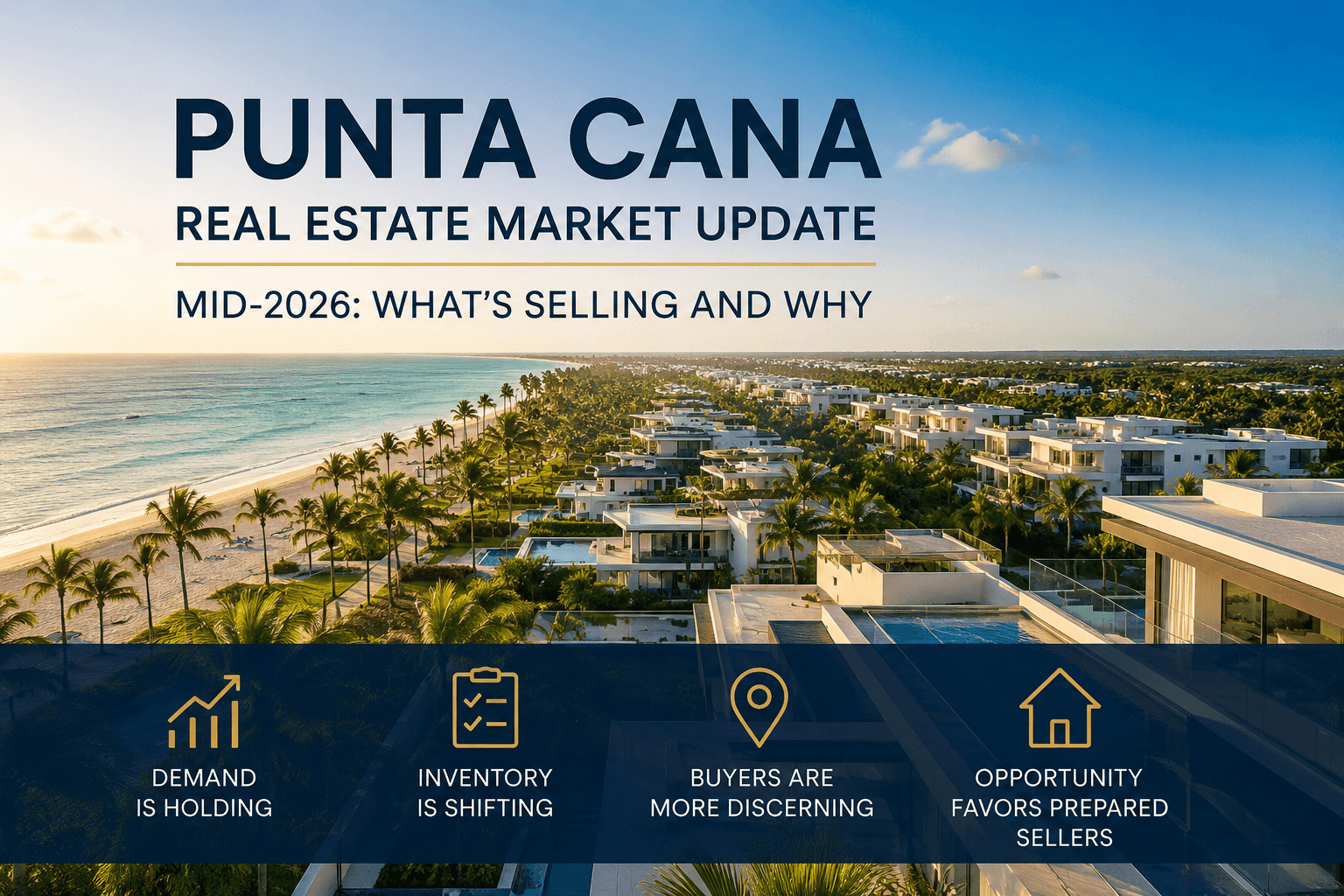
We’re now six months into 2026, and if you’ve been watching this market or thinking about entering it, the mid-year point is worth a proper assessment. Not a headline spin. Not a developer pitch. A straightforward look at what’s actually happening: what’s moving, what’s stalling, where prices are, and what I’m telling buyers who are actively in the market right now.
After 13 years in Punta Cana, I’ve lived through several market cycles: the COVID year of no flights and frozen closings, the 2021–2022 surge that caught a lot of people off guard. Each cycle teaches you something different. What I’m seeing in mid-2026 is distinctive and it matters if you’re a buyer deciding whether now is the right moment.
The short version: the Punta Cana market is healthy, but it has bifurcated. Certain product types and locations are outperforming significantly. Others have cooled. Knowing which is which is the difference between a smart acquisition and an average one.
The Big Picture: Demand Is Holding, Inventory Is Shifting
The Dominican Republic closed 2025 with record tourism numbers over 12 million international arrivals, with the Punta Cana region capturing approximately 68% of that total. The tourism engine that drives rental demand in this market is not just intact; it’s growing.
That demand backdrop has kept transaction volume solid through the first half of 2026. What’s changed is the composition of what’s selling and the pace at which deals are moving.
In 2021 and 2022, almost anything sold quickly and at asking. Developers were raising prices quarterly. Buyers who hesitated often lost the unit they wanted. That froth has normalized.
What we have now is a more discerning market. Well-priced, well-positioned product in the right communities still moves in weeks. Properties with location challenges, developer reputation questions, or pricing that doesn’t reflect current comparables are sitting longer.
This is actually a better market for prepared buyers than the feeding-frenzy years were. There’s time to do proper due diligence. Negotiation is possible again. But you still need to move decisively on the right opportunities, they don’t expire, but they do get competition.
What’s Selling: The Three Categories Outperforming the Market
1. Branded Residences and Hospitality-Linked Product
The single strongest segment of the market in mid-2026 is branded residences, units within or affiliated with international hotel brands. Marriott, St Regis, and Windham all have residential product at various stages in the Punta Cana corridor, and this category is absorbing buyer demand faster than any other.
Why? Because buyers have figured out something that took time to get traction: a branded residence is not just a lifestyle purchase. It’s a product with built-in rental management, recognizable brand credibility for platform listings, and guest trust that translates directly into occupancy rates.
A non-branded condo in a good location might achieve 60–65% occupancy under competent management. A branded residence in the same corridor same beaches, same access, typically runs 70–80% with higher nightly rates, because the brand provides the marketing reach and the quality assurance that justifies the premium to renters.
Entry prices for branded residential product in the Punta Cana market currently range from approximately $420,000 to $750,000 for one- and two-bedroom units. Larger units and penthouse configurations scale significantly higher.
2. Cap Cana: Still the Market Leader for Luxury Buyers
Cap Cana continues to be the most active segment of the luxury market, and its outperformance isn’t slowing. The master-planned community has crossed a critical threshold: it now has enough inventory of resale properties that buyers can evaluate based on comparables rather than developer projections alone.
Current price benchmarks for Cap Cana in mid-2026:
- Condos (1–2 bedrooms): $380,000–$550,000 depending on size, building, views, and amenities
- Villas (3–5 bedrooms): $850,000–$3.5M+ depending on finishes and location
- Beachfront and Juanillo-area product: Premium pricing reflects exceptional demand for direct water access
The infrastructure buildout in Cap Cana continues at pace. Several hotel projects that were under construction in 2025 are now open or nearing completion. Each hotel opening increases permanent foot traffic and service quality, reinforcing property values across the development.
3. Bávaro Pre-Construction at the Right Developer
Pre-construction sales in Bávaro and the broader Punta Cana resort corridor continue to attract strong buyer interest, but the quality of what’s on offer has become more important than ever.
What’s selling in the pre-construction segment is product from developers with: completed, delivered projects buyers can walk through; clear Confotur certification; transparent construction timelines; and established property management operations.
Pre-construction pricing in Bávaro currently starts around $140,000–$230,000 for one-bedroom units in quality projects, scaling to $350,000–$500,000 for two-bedrooms in premium developments with beachfront access.
What’s Stalling: Where I’m Telling Buyers to Be Careful
Isolated Condo Projects Without Rental Management Infrastructure
There is a segment of the Punta Cana market that has been oversupplied with undifferentiated condo product, mid-range units in locations that aren’t quite beachfront, without established rental programs, and without a clear competitive advantage in a crowded field.
The rule of thumb I use: if a property doesn’t have an answer to the question “Why would a renter choose this over the resort next door?” it’s a management challenge, not a passive income asset.
Properties Priced Off 2022 Peaks in Secondary Locations
Some sellers are still pricing their properties based on the peak valuations of 2021–2022, without adjusting for the normalization that’s occurred since. In primary locations, Cap Cana, beachfront Bávaro — those prices may still be defensible. In secondary locations, they’re not.
These properties sometimes become value opportunities when sellers finally adjust.
Rental Yield Reality Check: What’s Actually Generating Returns
One of the most common misconceptions I hear from buyers is treating yield projections from developers as market data. They’re not. Here’s what I’m actually observing:
Cap Cana branded/managed units: Occupancy 68–78% | Avg. nightly rate $350–$750 | Gross yield 7–10% | Net yield 5–7%
Quality Bávaro beachfront condos: Occupancy 60–72% | Avg. nightly rate $260–$475 | Gross yield 6–9% | Net yield 5–8%
Mid-range non-beachfront condos: Occupancy 45–60% | Avg. nightly rate $90–$280 | Gross yield 6–8% | Net yield 4–6%
Net yield after all costs is rarely as high as the headline number in a developer brochure — but for the right product in the right location, 5–7% net is achievable and compares very favorably to equivalent-quality real estate in North America or Europe.
Price Appreciation: What the Past 12 Months Have Looked Like
- Cap Cana premium product: Approximately 8–11% appreciation over the past 12 months
- Bávaro beachfront: Approximately 8–10% — solid and more moderate as the segment matures
- Pre-construction to delivery gains: Buyers who purchased in 2024 and are taking delivery in 2026 have generally seen 25–40% appreciation
The Currency Advantage: Why Dollar Buyers Remain Dominant
The Dominican Republic’s property transactions are priced and settled in US dollars. For buyers from the US and Canada, this removes currency risk entirely. For European buyers, the USD/EUR relationship has been broadly favorable, adding an effective discount for buyers from the eurozone.
What Smart Buyers Are Doing Right Now
- Focusing on fundamentals, not frenzy. Beach access. Developer quality. Established management infrastructure.
- Verifying Confotur status. A properly structured Confotur purchase can save $40,000–$80,000 in taxes over the exemption period.
- Thinking about the exit from day one. Who will buy this property when I’m ready to sell? Is there a real resale market?
- Working with agents who know the specific communities. Local knowledge is worth more here than almost anywhere else I’ve worked.
- Moving when they find the right property. Quality properties in primary locations still attract multiple interested buyers.
My Overall Mid-2026 Assessment
This is a good time to buy in Punta Cana if you’re buying the right thing. The market has come off the peak froth of 2022. There’s more inventory to evaluate. Negotiation is possible. The tourism engine driving rental demand is at record levels and growing. The legal and tax framework remains the most favorable in the Caribbean for foreign buyers.
The question isn’t whether to buy in Punta Cana. The question is what to buy, where, and with whom. Those decisions determine everything.
Ready to Make a Move?
If this market update has you thinking seriously about the Punta Cana market, the next step is understanding the full process — not just the what, but the how.
Our Punta Cana Real Estate Buyer’s Guide covers everything a foreign buyer needs to execute a clean transaction: the legal process step-by-step, developer vetting, Confotur verification, and the due diligence checklist I use for every transaction.
Browse our current listings — or reach out directly and tell me what you’re looking for. After 14 years, there aren’t many properties in this market I haven’t walked through.
Alex Bucher is a real estate broker with Coldwell Banker Prime Realty, based in Punta Cana. He has spent 14 years working exclusively in the Dominican Republic market, specializing in foreign buyer transactions across Cap Cana, Bávaro, and the eastern coast.
