
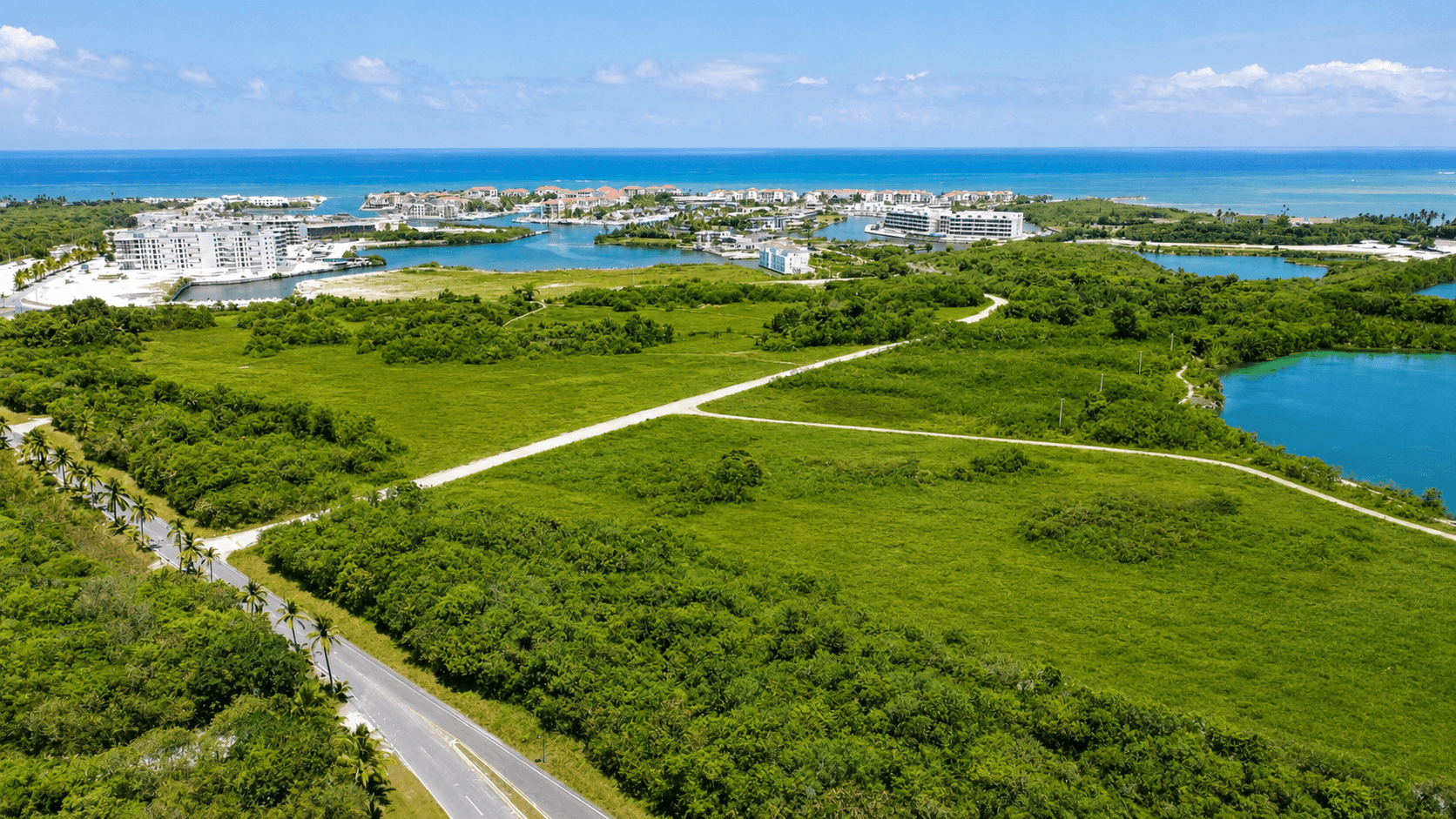
When buyers ask me why Cap Cana commands a premium over the rest of the Punta Cana corridor, the answer isn’t just the beaches — though Playa Juanillo is genuinely one of the most beautiful stretches of coastline in the entire Caribbean. The answer isn’t the golf, either, even with Punta Espada consistently ranking among the best courses in Latin America.
The real answer is infrastructure. And in 2026, that infrastructure story is accelerating.
I’ve been watching Cap Cana’s development trajectory for over a decade. What’s happening right now across the marina, the hotel corridor, the road network, and the residential zones — is the kind of sustained, coordinated investment that directly and measurably moves property values. If you’re evaluating Cap Cana as an investment or considering a purchase, understanding what’s being built, who’s building it, and what it means for your specific position in the market is not optional. It’s the work.
Here’s my honest read on where things stand.
What Makes Cap Cana Structurally Different from the Rest of the Punta Cana Market
Before diving into the specific developments, it’s worth understanding why Cap Cana responds differently to infrastructure investment than the broader Punta Cana/Bávaro market does.
Cap Cana is a master-planned private community, approximately 30,000 acres of land that was acquired, planned, and developed under a single governance structure from the outset. This is fundamentally different from how Bávaro and the broader Punta Cana corridor developed, which was organic: hotel chains acquired coastline, developers built where land was available, and the road and utilities infrastructure struggled to keep pace with demand.
Cap Cana was designed in the opposite direction. Land use was designated before construction began. Roads were engineered for anticipated density, not retrofitted around it. Utilities; water, power, waste were built as community-wide systems rather than assembled piecemeal per project. A dedicated architectural review body, the Consejo de Dirección, Planificación y Desarrollo (CPD), reviews all significant new construction against published standards that govern height, massing, materials, and siting.
This governance structure has a direct financial consequence: infrastructure investments in Cap Cana compound across the entire community rather than benefiting only their immediate neighbors. When the marina expands, it lifts value in the marina-adjacent districts. But it also lifts the value of properties a kilometer away that now market themselves as “minutes from one of the Caribbean’s premier yacht facilities.” When a luxury hotel brand opens inside the gates, it adds credibility to every property address in the zip code, not just the immediate resort area.
This is the mechanism. Keep it in mind as I walk through what’s actually happening.
Marina Cap Cana: The Expansion That Changes the Waterfront Math
Marina Cap Cana has been the gravitational center of the community’s social and commercial life since its early development. With its mix of yacht berths, restaurants, boutiques, and a walkable waterfront promenade, it created the kind of live-work-play infrastructure that attracts a specific and high-spending buyer demographic.
What’s unfolding now takes it further.
The marina has been undergoing a phased capacity expansion that is adding significant berthing capacity for larger vessels, a direct response to demand from the regional superyacht and charter market that has been growing alongside Caribbean ultra-luxury travel. For context: the ability to accommodate deep-draft, 100-foot-plus vessels is not something most Caribbean marinas can offer. Cap Cana’s geography, with its natural harbor and depth, gives it an advantage here that most competitors simply cannot replicate.
What this means for property values is specific and measurable. Marina-adjacent condos and penthouses in Cap Cana have historically commanded a meaningful premium over comparable product in the interior of the community. That premium has been expanding as marina infrastructure improves, because the buyer and renter who prioritizes marina access is also the buyer and renter who is least price-sensitive and most brand-conscious.
If you own or are evaluating marina district property in Cap Cana right now, you’re holding in the zone with the most direct infrastructure tailwind in the community.
Luxury Hotel Brands: What New Flags Actually Mean for Residential Values
The single most consequential infrastructure development for property values in any resort real estate market is the arrival of a luxury international hotel brand. Not because the hotel itself generates revenue for nearby property owners – it doesn’t, directly. But because the process of a major hospitality brand entering a market requires intensive diligence that functions as a third-party validation of the location.
When a brand like Eden Roc, Hyatt, St. Regis , or a comparable ultra-luxury flag selects a site, they have done the work. They’ve analyzed airlift, demand trends, competitive positioning, legal infrastructure, security, utility reliability, and long-term market trajectory. Their team has spent months or years on the decision. When they commit, they are signaling something to the market.
Cap Cana has been attracting exactly this category of brand attention. The community has seen growing interest from ultra-luxury hospitality groups seeking to establish Caribbean flagship properties, and the combination of Cap Cana’s governance model, existing infrastructure quality, land availability, and the Punta Cana airport’s international connectivity, it handles approximately 64% of all air arrivals in the Dominican Republic — makes it one of the most compelling sites in the entire Caribbean for large-scale luxury resort development.
For residential property owners, what a luxury hotel flag delivers is: elevated nightly rate comparables for vacation rentals, an improved international buyer profile for resale, higher perceived prestige of the address, and measurable increases in tourist spending in the surrounding commercial areas. None of these effects are theoretical. They’ve played out in other Caribbean markets, in Turks and Caicos with Grace Bay, in the Bahamas with Albany, and they’re playing out in Cap Cana.
The Road and Connectivity Improvements: Less Glamorous, More Impactful
Infrastructure conversations in real estate tend to focus on amenities, the marina, the golf, the hotel brand. But in my experience, nothing moves property values more predictably than road connectivity improvements, and that’s an ongoing story that doesn’t get enough attention from buyers.
Cap Cana’s internal road network has been progressively upgraded alongside the community’s development. But the most consequential improvements are happening at the boundary between Cap Cana and the broader Punta Cana corridor, specifically the arterial connections that link the community to the airport, to the Bávaro commercial zone, and to the coastal highway that runs south toward Bayahibe and La Romana.
The practical effect of these improvements: reduced commute times between Cap Cana and the airport (a critical variable for property renters who weigh convenience as heavily as amenity quality), better access to commercial services for permanent residents, and improved logistics for property management operations. For vacation rental operators, shaving meaningful time off the airport-to-property transfer is not trivial, it directly affects guest reviews and repeat booking rates.
There’s a second-order effect that matters for long-term valuation: improved connectivity expands the catchment of demand for Cap Cana property. When the travel time from PUJ to Cap Cana’s front gate is tight and predictable, the community becomes viable for shorter stays – weekend escapes, long weekends, flying in Thursday and leaving Sunday. These short-stay patterns represent a different and incremental demand segment that was historically underserved by the community’s previous connectivity profile.

Cap Cana infrastructure improvement
Golf Infrastructure: From Punta Espada to Las Iguanas
For years, Punta Espada Golf Club—a Jack Nicklaus Signature course consistently ranked among the finest in the Caribbean and Latin America, has been one of Cap Cana’s defining assets. Its dramatic oceanfront holes along the Caribbean Sea have helped establish the community as one of the premier luxury golf destinations in the region. More than just an amenity, Punta Espada has become a globally recognized brand that adds measurable value to surrounding real estate. Properties overlooking the course or within close proximity consistently command stronger buyer interest and rental premiums.
What makes Cap Cana even more compelling today is that it is no longer a one-course destination. The highly anticipated Las Iguanas Golf Course, also designed by Jack Nicklaus, is rapidly taking shape. The first nine holes are already completed and operational, while the remaining nine holes, along with the driving range and practice facilities, are nearing completion. Like Punta Espada, Las Iguanas features spectacular coastal holes overlooking the Caribbean Sea, offering a completely different yet equally impressive golfing experience.
This expansion represents a significant milestone for the community. By offering two championship Jack Nicklaus golf courses, Cap Cana is positioning itself among an elite group of luxury destinations worldwide. Multi-course golf resorts attract a broader range of visitors, including international golf travelers, corporate retreats, tournaments, and specialized tour operators. More importantly for property owners, this creates additional and more diversified sources of rental demand throughout the year.
From an investment perspective, the implications are meaningful. Homes and condominiums with golf views, golf frontage, or convenient access to either clubhouse occupy some of the most defensible real estate positions within Cap Cana. As the second course reaches full operation, the community’s appeal to affluent buyers and repeat visitors is expected to strengthen further, reinforcing both property values and long-term rental performance.
Residential Zone Development: What New Project Activity Signals
The pace and profile of new residential development inside Cap Cana provides a real-time signal about where professional developers — who have access to the best market data — believe value is being created.
Current development activity shows concentration in a few distinct patterns:
Luxury boutique condo projects are targeting the $500,000–$1.2M range, with smaller unit counts (30–80 units), elevated finishes, and a positioning that competes directly with villa ownership on the basis of managed maintenance and amenity access. These projects are absorbing significant capital from North American and European buyers who want the Cap Cana address without the operational complexity of managing a standalone villa.
Pre-construction villa communities in the interior and coastal zones continue to draw buyer interest at the $900,000–$3M+ range, occasionally with Confotur exemptions available on qualifying projects providing meaningful tax structuring advantages.
Mixed-use developments adjacent to the marina district are creating residential units above commercial and dining ground floors — a product type new to Cap Cana that reflects the community’s maturation from pure resort to genuine urban lifestyle destination.
The common thread across all of these development profiles is conviction, developers of this caliber don’t commit capital to projects inside a market unless the underlying infrastructure thesis supports it. What’s being built in Cap Cana right now is a vote of confidence from sophisticated real estate capital that the infrastructure improvements being made at the community level translate into durable demand at the residential level.
What This Means for Resale Values: The Honest Analysis
I’m not going to project specific appreciation percentages. Anyone doing that is selling you something. What I will do is give you the honest framework I use when I advise buyers in this market.
Cap Cana property has historically commanded a significant premium over comparable Bávaro/Punta Cana product — typically 30–60% per square meter at equivalent quality tiers. That premium is not arbitrary. It reflects the governance quality, infrastructure reliability, beach quality at Juanillo, the brand credibility of the master plan, and the Confotur tax advantages available on qualifying projects.
The current infrastructure cycle is widening that premium rather than compressing it. Each luxury hotel flag, each marina expansion phase, each road connectivity improvement, and each new high-end development adds to the credentials that justify the premium at the top of the market. Buyers who purchased in Cap Cana three to five years ago at what felt like premium prices have in many cases seen meaningful appreciation relative to comparable Bávaro product.
The risk to the thesis is what it always is in resort real estate: external demand shocks. A sustained decline in North American or European discretionary travel spending, a significant regional security event, or a major hurricane with structural damage to the community’s infrastructure would all create headwinds. These risks are real and shouldn’t be dismissed. They’re also the risks you accept in any Caribbean resort investment — Cap Cana is not uniquely exposed to them, and its infrastructure quality arguably positions it to recover from external shocks faster than less-developed markets.
The specific positions I consider strongest right now:
- Marina district condos and penthouses (direct infrastructure tailwind from marina expansion)
- Golf-view and golf-adjacent properties (durable premium, strong rental positioning)
- Confotur-eligible pre-construction with delivery in the next 18–42 months (value capture from ongoing infrastructure investment before it’s fully priced in)
- Beachfront and beach-access properties in the Juanillo zone (supply-constrained, high-end rental demand consistent)
The positions I consider weakest:
- Interior units in older condo complexes without significant renovation and updated amenity profiles
- Properties at the Bávaro-adjacent end of the market that carry the Cap Cana name without the full benefit of the core community infrastructure
- Over-leveraged pre-construction commitments on projects with unproven developer track records
The Confotur Calculation Inside Cap Cana
One factor that separates Cap Cana from several other DR markets is the availability of Confotur tax exemptions on qualifying developments. Confotur — the Dominican Republic’s tourism investment incentive law — provides exemption from the 3% property transfer tax and from annual property taxes on the assessed value for up to 15 years on certified tourism-development projects.
In a community where entry prices start above $400,000 and can reach several million dollars, the transfer tax exemption alone at acquisition can represent $12,000–$60,000 in savings on a single transaction. The ongoing annual property tax exemption on assessed values above the standard exempt threshold compounds significantly over a hold period.
Not every Cap Cana project carries Confotur. Resale transactions involving properties past their certification period, or developments built before the program was widely applied, may not carry exemptions. This is a due diligence item not an assumption — and it belongs on the checklist for every buyer evaluating a specific property.
For pre-construction buyers in qualifying new projects, Confotur eligibility is one of the most significant financial variables in the acquisition decision. The tax structuring implications compound across a 10–15 year hold to a degree that can meaningfully shift the total return calculation.
My Honest Assessment as of Mid-2026
Cap Cana is not a discovery story anymore. The buyers who got in early at pre-discovery prices did very well. What Cap Cana is now is a maturation story, a market that is methodically building out the infrastructure that converts it from a premium DR resort community into a world-class destination that competes with the best of the Caribbean.
That maturation has a financial signature. It means the entry price floor keeps moving. It means the resale comps available to you in 3–5 years will likely be materially stronger than the comps available today. It means the rental rates you can charge on a well-positioned property next year should be higher than those available today, because the guest experience keeps getting better as the infrastructure gets better.
I’m not telling you Cap Cana is cheap. It isn’t. I’m telling you that the current infrastructure investment cycle, the marina, the hotel brands, the road improvements, the new residential development profiles — provides a well-supported thesis for why today’s premium, measured against the trajectory, is justified.
Whether a specific property, at a specific price, in a specific position within Cap Cana makes sense for your situation requires a more detailed conversation. That’s what I’m here for.
Ready to Evaluate Cap Cana Seriously?
If you’re at the point where Cap Cana is on your shortlist or you want the full framework for evaluating any DR real estate purchase with the same diligence a professional would apply — start with the fundamentals.
Our Punta Cana Real Estate Buyer’s Guide covers the complete legal and transactional process for foreign buyers, including Confotur eligibility verification, title deed due diligence, developer vetting criteria, and the step-by-step acquisition process. It’s the same framework I walk through with every buyer I represent.
When you’re ready to look at specific Cap Cana opportunities, browse current listings — or reach out directly for an unfiltered conversation about how Cap Cana fits your specific investment timeline, budget, and goals.
Alex Bucher is a licensed real estate broker with Coldwell Banker Prime Realty, based in Punta Cana. He has spent 9 years working exclusively in the Dominican Republic market, specializing in foreign buyer transactions across Cap Cana, Bávaro, and the entire eastern and southern coast.
